

Jenny Wright
Unwrapping the layers of my great-great grandparents’ story has taken 14 years of extensive research (so far). As readers of this newsletter would know, the story can be wellburied when an ancestor is Chinese. The knowledge I gained from researching public records and newspaper reports, visiting the
places they lived, and learning from local and family history groups enabled me to develop a framework.
Email: jenawright27@gmail.com
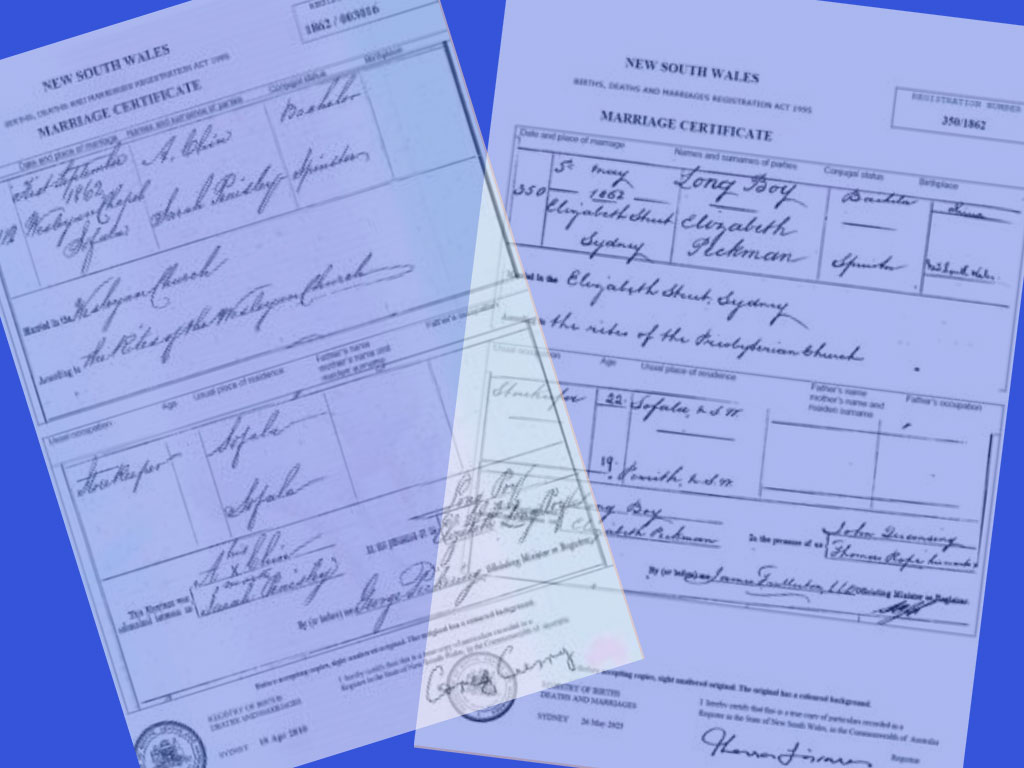
Sarah Gale married Ah Chin in 1862 in Sofala, New South Wales. There was rich detail in official records about Sarah’s convict parents, but Ah Chin’s background was elusive. Limited documentation in marriage and children’s birth records did not show his name in Chinese characters or his village of birth. There is no known gravestone for him.
However, I have found much more by reading the history of the times and exploring the lives of the people around them.
The history of the arrival of the Chinese gold seekers into Australia in the mid-nineteenth century matched with documentary sources, led me to the theory that Ah Chin arrived in Sydney in the early 1860s and that he initially went to the Lambing Flat goldfield – before escaping to Sofala after the 1861 riots.

Marriage Certificate
A. Chin & Sarah Gale [known as Sarah Peaisley], Marriage Certificate, 1 September 1862, Sofala, Births Deaths & Marriages New South Wales (BDM NSW), 3016/1862.
I was interested in reading Juanita Kwok’s account of the 1864 Tuena petition signed by the Chinese men who sustained losses in the Lambing Flat riots.1 In the list of signatories, there were several men named Ah Chin. Our Ah Chin’s location was relatively close to Tuena – in Sofala, where their first child Emily was born in June 1863 – and subsequent travel to Nerrigundah where Martha was born in April 1865, meant he could have been one of those men.2
I followed another line of research as a detective pursues associates of their ‘suspects’. I traced the couple who witnessed the Ah Chin marriage. From the first time I saw Sarah and Ah Chin’s marriage certificate, I had wondered about Long Poy and Elizabeth Long Poy. If I could find out more about this mixed-race couple, perhaps I would uncover some of Sarah and Ah Chin’s secrets.
Clues from other Chinese Australian researchers set me on the path to learning more about the Long Poys. I had hoped to find a clear connection between Ah Chin and Long Poy and, by association, learn more about Ah Chin. Although they may have travelled together and come from the same or similar area in China, I could not find a specific link between the two men.
Instead, I found a strong and ongoing connection between Sarah and Elizabeth. They were born about a year apart in Penrith, western Sydney,3 and may have known each other as children. Both married Chinese men in 1862.4 The Ah Chins moved to the south coast of New South Wales, while the Long Poys went to Victoria.

Long Poy was involved in a scuffle, resulting in the fatal shooting of a countryman. He was sentenced to death by hanging in Castlemaine Gaol in March 1866, despite speculation of a wrongful conviction.5 By the end of that year, Elizabeth had returned to Sofala with her daughter and remarried.
In 1872, the two families reconnected in Ravenswood, west of Townsville, in north Queensland. They lived in the same part of town, and their children attended the local school. Swee Sang, Elizabeth’s husband, worked in various occupations, including carrier, storekeeper, and publican. Ah Chin was a miner, cook and publican. Elizabeth was the midwife for the birth of Sarah’s daughter (Sarah) in 1875.
Again, the families went their separate ways – the Swee Sangs moved to Charters Towers, and the Ah Chins went to the Palmer River goldfield. Sarah Ah Chin gave evidence in the Court of Petty Sessions at Maytown in July 1876.6
The families met in Charters Towers at the end of the decade after Sarah’s husband, Ah Chin, disappeared. For a time, they all lived near Gard’s Lane, known as the centre of Chinese activity in the town. Children from each family attended the Charters Towers Central State School in the late 1870s and early 1880s.7 Another illustration of the intersection between the two families was when two of Sarah’s children were witnesses at the marriage of one of Elizabeth’s daughters in 1890.8
By changing my focus and imagining my ancestors in the historical context and community in which they lived, I have uncovered new chapters in their stories.
The first draft of my book about Sarah and Ah Chin is nearing completion. I plan to publish it sometime in 2026.
References
- Juanita Kwok, ‘The Lambing Flat riots and the Chinese quest for compensation’, Journal of Australasian Mining History, Vol. 20, October 2022, p. 100. ↩︎
- Emily Ah Chin, born Sofala 1863, Births Deaths & Marriages New South Wales (NSW BDM), 13665/1863; Martha Ah Chin, born Nerrigundah 1865, NSW BDM, 7331/1865. ↩︎
- Sarah Gale was born on 27 November 1842 – BDM NSW, Baptism Certificate No. 1168/Vol. 26A. Elizabeth Peckman [Peckham] was born in about 1843 – she was 19 years old at the time of her marriage in May 1862. ↩︎
- Elizabeth married Long Poy in Sydney in May 1862 – BDM NSW, 1862/350; Sarah married Ah Chin in Sofala in September 1862 – BDM NSW, 1862/3016. ↩︎
- ‘The Execution of Long Poy’, Herald (Melbourne), 12 March 1866, p. 3. ↩︎
- Evidence of Sarah Ah Chin and Sarah Ah Bow, 12 July 1876, Court of Petty Sessions, Maytown, Minutes of Proceedings – Police Court, Queensland State Archives, Item ID ITM5870. ↩︎
- Sandi Robb, ‘North Queensland’s Chinese Family Landscape: 1860-1920’, Doctor of Philosophy thesis, James Cook University, 2019, pp. 278, 280-281, 286, 289. ↩︎
- Theresa Swee Sang and William James Palmer, Marriage Registration, 10 April 1890, Queensland Births Deaths and Marriages, 1890/C/1172. ↩︎
Leave a Reply